Layering done well looks accidental, like you got dressed once a year ago and the pieces just stayed on. Done badly, it looks like you raided a costume drawer. The difference is a small set of rules. Here is how to build the look on purpose, without it feeling staged.
Start with a hero piece
One piece does the heavy lifting. Everything else supports it. The hero is usually the longest, the heaviest, or the most detailed thing you are wearing, and the rest of the layers are deliberately quieter so the hero has room to breathe.
For necklaces: the hero is your longest chain or your boldest pendant. For bracelets: a tennis bracelet or a chunky cuff. For rings: a signet, a statement stone, or a wide band.
Mix lengths, not weights
This is the single most common mistake. People layer three chains of identical length and wonder why the result looks tangled instead of intentional.
For necklaces, work in tiers:
- Choker (35-40cm), sits at the base of the neck
- Princess (42-46cm), hits just below the collarbone
- Matinee (50-60cm), lands at the centre of the chest
- Opera (70-90cm), longer, drapes onto the sternum
Pick two or three lengths, leave at least 5cm of space between each so they do not knot, and let one length carry the hero piece.
Stick to one metal family
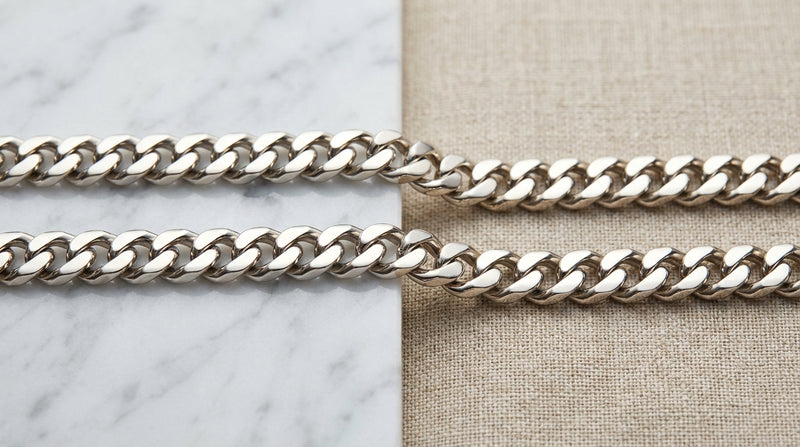
You can break this rule, but only on purpose. The default is: all white-tone (plated white gold, silver, stainless steel) or all warm-tone (yellow gold, rose gold). Mixing tones is a power move that requires either a unifying piece (like a two-tone bracelet) or strong styling intent. If you are not sure, stay in one family.
Within a tone family you can absolutely mix materials. A 925 silver chain plus a stainless steel bracelet plus a plated white gold ring all look like one curated set, even though they are three different metals.
The bracelet stack
Three to five pieces is the sweet spot. More than that reads as cluttered.
The classic recipe:
- One watch (or one chunky bangle as the anchor)
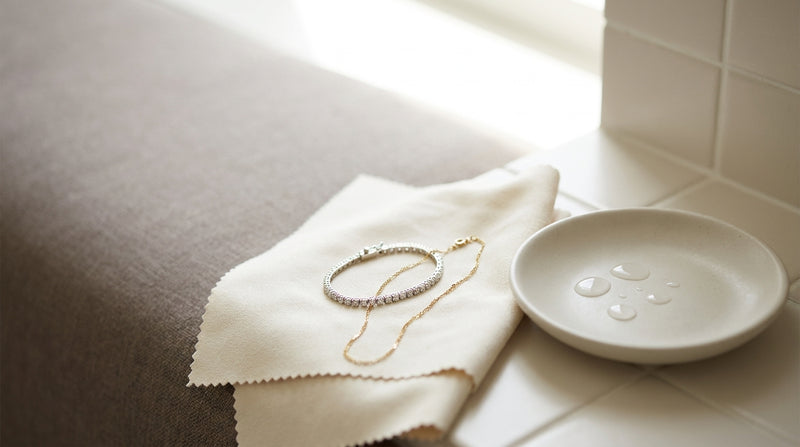
- One tennis bracelet (the sparkle layer)
- One thin chain or beaded piece (the texture layer)
- Optional: a signet bracelet or charm piece for personality
Spread the visual weight. Do not stack three identical thin chains right next to each other, you will not see them. Alternate big-small-big-small or thin-thick-thin to give the eye somewhere to land.
The ring stack
Rings follow the same rules but with one addition: the index, middle, and ring fingers carry the load. Pinky and thumb are accents.
A safe starter stack:
- Index finger: a thin band or a signet
- Middle finger: nothing, or a small statement
- Ring finger: your hero (could be a wedding ring, an heirloom, a single big stone)
- Pinky: a thin chain ring or a knot ring
Resist the urge to load every finger. A confident hand has space.
Earrings: balance the face, not the ear
If you are wearing big earrings, keep necklaces shorter and quieter so the eye is not split between two competing focal points. If you are wearing layered necklaces, smaller studs or a single hoop work better.
For a stacked ear (multiple piercings), follow the same lengths-not-weights rule: alternate stud, small hoop, stud, larger hoop, climbing up the lobe. Same metal family.
What to avoid
- Three of the same thing: three identical chains, three matching tennis bracelets, three thin bands. Variety is what makes layering look intentional.
- Heavy plus heavy plus heavy: cluttered. One hero, supporting layers underneath.
- Mixing two metals on accident: a rose-gold piece in an otherwise silver stack stands out for the wrong reason.
- Layering for occasion that does not call for it: a packed stack reads as styled, not casual. Match the layering density to the energy of the rest of the outfit.
The Zero Degrees approach
Our catalogue is built for layering. Most of our chains come in matched lengths so you can buy two pieces from the same line and know they will sit cleanly together. Our Chrono line is designed as a hero family, our 925 silver collection is built to support it, and the stainless steel range fills out the everyday layers.
If you are layering across our materials lines for the first time, pick one tone (we recommend white) and one hero piece, then let our stylists help you build the rest. Free, by appointment.